
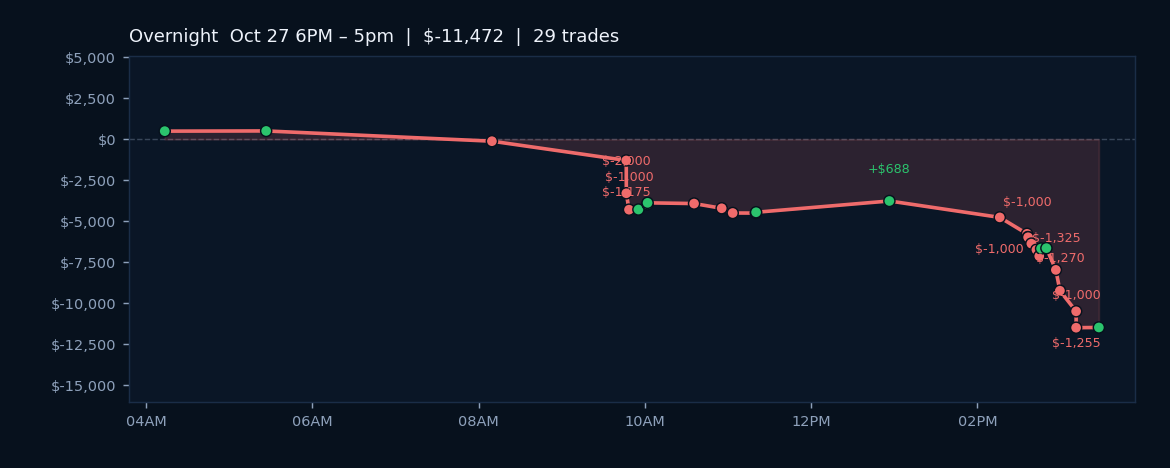
The algos drew down -5.13% off cumulative total P&L on Tuesday, registering a net loss of $11,472.50 as 29 trades yielded just a 34.5% win rate with 10 winners and 19 losers. Gross profit totaled $2,165.00 (13.7% of total gross), while gross losses consumed $13,637.50 (86.3%), producing a 0.16 profit factor that reflects heavy drawdown pressure. Average winners landed at $216.50 per contract, unable to offset average losers of $717.76, a risk/reward imbalance that AI analysis now flags as critical across multiple simulations.
The regime remains locked in low_vol at 100% confidence, which typically constrains breakout momentum and widens the cost of false entries. AI Pi at 54.4% signals only marginal directional tilt, while AI Sentiment reads negative, creating a headwind for trend-following strategies. ES opened range-bound between 7763.75 and 7777.25, eventually rejected near overnight highs, while NQ's overnight range 29379.8 to 29589.5 set a wide gauntlet for intraday fills. The day unfolded against the backdrop of FOMC decision and press conference this afternoon, with Advance GDP and Core PCE data due tomorrow, plus MSFT and GOOGL earnings after the close—macro anchors that historically tighten spreads and dampen entry quality during the final hours before headline risk.
Active AI recommendations now flag the urgency of enforcing daily loss limits near $1,715 across ES simulations and blocking weak 5-minute entry buckets (08:30, 13:00, 10:10, 04:05, 15:30 have shown negative average PnL). The current max drawdown sits at $12,175, already exceeding the suggested threshold. Without tighter entry discipline, cumulative P&L erosion will accelerate into an environment where seasonality data from midterm-year trading weeks (n=19 years) shows the next five sessions average -0.06% with a 58% win rate—below the long-term baseline of +0.18%—pointing to a mixed but slightly defensive period ahead.