
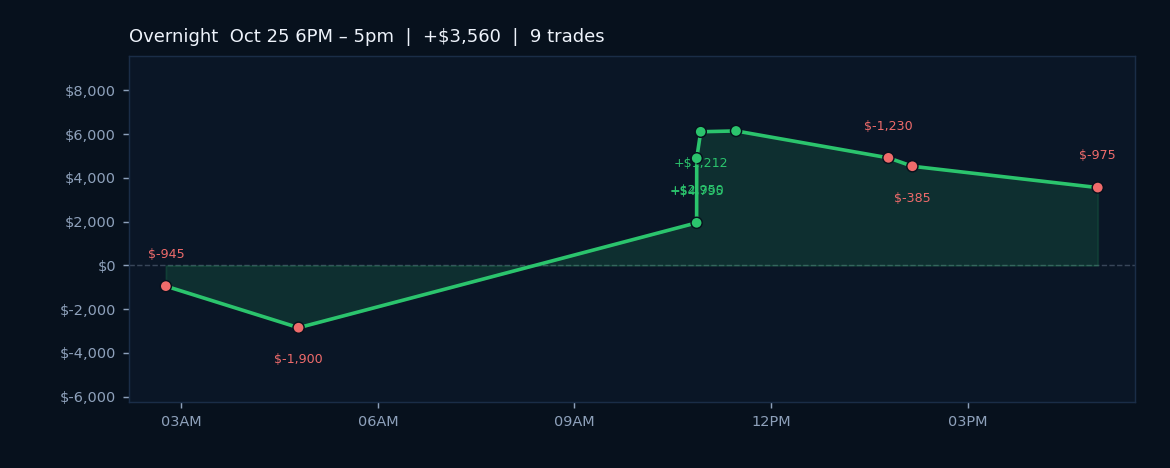
The algos grew by +1.65% on the session, extending cumulative total P&L to $219,333.44. Nine trades produced $3,560.00 in net gains, though the underlying execution was uneven: the win rate settled at 44.4% (4 winners, 5 losers) with a profit factor of 1.66. Gross profit landed at $8,995.00 against gross losses of $5,435.00, yielding an average winner of $2,248.75 and an average loser of $1,087.00. The session unfolded in a regime flagged as chop with 100% confidence, a structural headwind that typically constrains both directional conviction and trade frequency in sideways price action.
Overnight, ES held a narrow range between 7660.00 and 7714.25, unable to reclaim the prior-day high of 7798.75, while NQ traded in a 29,006–29,279 band, similarly confined below its prior-day high of 29,993.20. The 6E held tight to 1.1208–1.1250, and crude (CL) rode volatile swings from 98.84 to 101.83 before closing near 99.10. Overnight headlines centered on OpenAI's mathematical breakthroughs (resolving the Kakeya and Stein conjectures, disproving the exponential time hypothesis), which surfaced as late-session commentary; separately, charges filed against former FBI Director James Comey added domestic political noise but did not spark cross-asset repricing. The broader tape absorbed these narratives without material directional conviction.
AI Sentiment reads positive and AI Pi stands at 36.2%, yet the regime system's chop classification dampened momentum-driven edge. The AI recommendations remain focused on loss containment: enforce daily loss limits (suggested $1,715.00 for the primary account, $1,230.00 for the edge variant) and block weak entry buckets clustering around morning sessions (08:30, 13:00, 10:10). With MSFT, GOOGL, and AMZN earnings queued for Oct 28–29, liquidity and implied volatility on NQ may spike, though the chop regime is unlikely to break decisively until fresh macro catalyst emerges.
Seasonality data for this point in midterm years favors the week ahead, with a +0.93% average return and a 74% win rate across 19 historical samples, setting a green backdrop that contrasts sharply with today's tight consolidation and low-probability trade selection.