
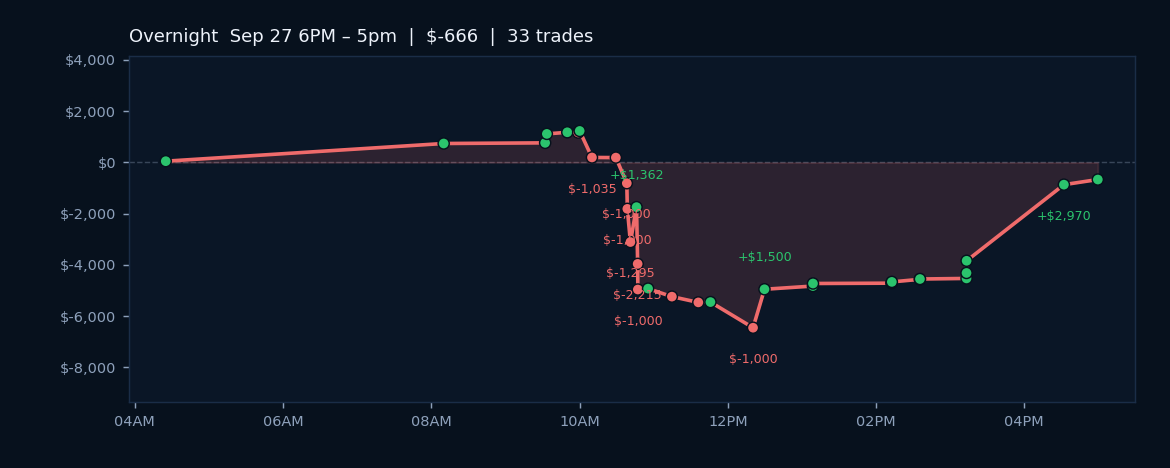
The algos drew down -0.36% on the day, booking a net loss of $666.25 against cumulative total P&L of $182,446.86, as 33 trades across ES, NQ, and related contracts encountered uneven execution throughout the session. The 66.7% win rate (22 winners, 11 losers) held solid, yet the profit factor of 0.93 reflected a structural imbalance: gross profit of $8,431.25 (48.1% of total gross) was outweighed by gross losses of $9,097.50 (51.9% of total gross), with average losers running nearly $827.05 versus average winners at $383.24. The asymmetry points to entry timing sensitivity rather than directional bias—a pattern the AI system's active recommendations have now flagged, with simultaneous loss-limit and weak-bucket blocks deployed across live sims to isolate and disable the 08:30, 13:00, and 10:10 UTC entry windows that have consistently underperformed.
Overnight, ES held above the prior-day close of 7746.25, with the opening range anchored between 7758.75 and 7775.25, while NQ struggled to sustain momentum above the overnight high of 30589—a tell-tale sign of Friday's momentum fade bleeding into Sunday's liquidity thinness. CL (crude) spiked to an overnight high of 97.42 before retreating well below the prior-day high of 98.91, a move likely tied to fresh Iran negotiations headlines (Qatari mediation, Strait of Hormuz reopening conditions) and Syria's gas supply disruption at the Jbeissa plant. Meanwhile, AI sentiment registered positive and the AI Regime remains locked in high_vol mode with 100% confidence, a regime typically prone to false breakouts on thin Sunday tape—hence the whipsaw risk embedded in today's loss tilt.
Macro air remains clear through Monday; no high-impact USD events loom in the next 48 hours, and NQ earnings slate is empty through early October. The headline noise around OpenAI's safety halt on GPT-6.1 Astra and new AI infrastructure deals (Firmus/Meta, Nuobikan placement) has kept sentiment buoyant, but the AI Pi reading of 48.6% sits neutral, neither pushing conviction long nor short. Seasonality tilts decisively green: S&P 500 midterm-year data from this exact calendar point shows the next trading week averaged +1.41% with a 63% win rate across 19 historical samples, well above the all-time baseline of +0.18%—a structural tailwind that should reward cleaner entries once the regime filter relaxes or bucket timing optimizations take hold.