
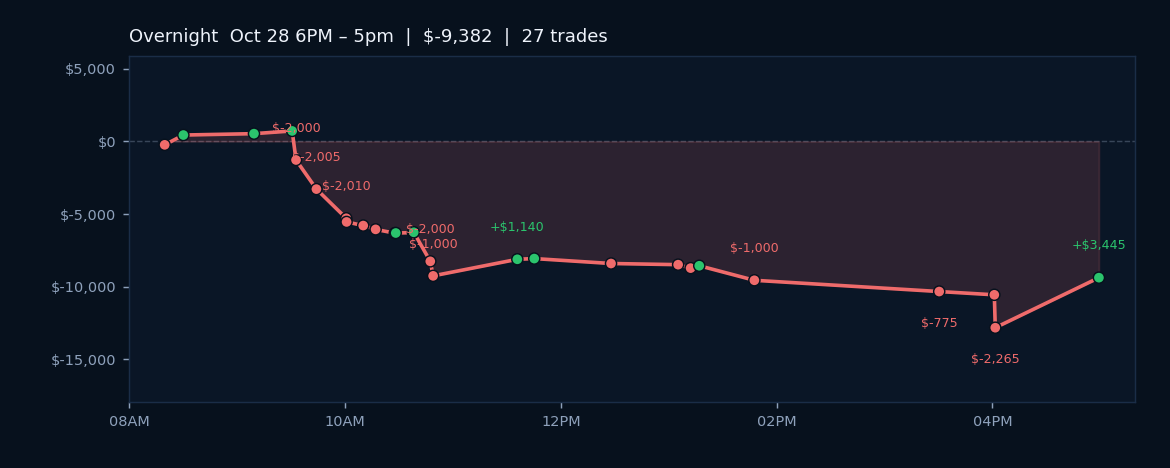
The session delivered a -$9,382.50 drawdown against cumulative total P&L, reducing the month's equity from prior session levels by 4.42%. Across 27 trades, the algos captured just 10 winners against 17 losers, posting a 37.0% win rate that sits well below statistical sufficiency. Gross profit totaled $5,817.50 (27.7% of total gross activity), but gross losses of -$15,200.00 (72.3%) overwhelmed gains, yielding a 0.38 profit factor that signals deteriorating signal quality. Average winner size of $581.75 versus average loser of $-894.12 confirms the asymmetry typical of choppy, range-bound regimes.
Market structure reinforced the challenge: ES held above the prior-day low of 7750.25 but failed sustained upside momentum, while NQ overnight lows near 29482.5 reflected broader tech sector pressure following Nasdaq futures dropping 1.4% in overnight trade. CL held within the 99.75 to 103.55 prior-day range, and 6E rejected moves above the prior-day high of 1.1191, all consistent with the AI Regime reading of chop at 100.0% confidence. The regime's signature sideways volatility created the conditions where entry-time clustering proved most damaging: active recommendations flag the weakest 5-minute entry buckets (08:30, 13:00, 10:10 among ES signals) for blocking, a tactical adjustment now urgent given today's skew.
Economic data arrived with Advance GDP forecast at 3.2% (prior 1.5%) and Core PCE Price Index m/m forecast at 0.3% (prior 0.2%), setting up potential data-driven volatility spikes that chop regimes often punish. AMZN earnings post-close today add layered uncertainty to overnight futures positioning. The AI Regime's continuation of chop, paired with AI Sentiment reading negative and AI Pi at 45.6%, maintains the structural headwinds that today's loss distribution exemplified; midterm-year seasonality from this point averages only +0.04% over the next week (58% win rate, n=19), offering no tailwind into the final week of October.